In America’s Dairyland, sharing the road with agriculture is a fact of life. But when a 1,500-pound Holstein wanders onto a dark highway in icy conditions, the result is often catastrophic. Who pays if you hit a cow on the road in Wisconsin? For injured drivers, the assumption is often that the farmer is automatically liable. However, the legal reality is far more complex.
To figure out what happens if you hit a cow with your car in Wisconsin, you need to know the specific legal duties that livestock owners have in Wisconsin.
Wisconsin’s “Animals at Large” and Fencing Statutes
Wisconsin prohibits any domestic animal, including cattle, horses, sheep, or goats, from “running at large.” Livestock owners have an affirmative duty to prevent their animals from running at large, or are strictly liable for certain damages caused by wandering animals.
If an animal is loose on the road, the court usually assumes the owner was careless because they broke a safety rule meant to protect people. The idea is simple: owners are responsible when their mistakes lead to animals causing accidents.
The “Legal Fence” Standard
A farmer can’t just use any material and call it a fence. Wisconsin law establishes clear guidelines for what constitutes a “legal fence” within the state. For example, a barbed wire fence usually must:
- Have at least three wires (four is the standard for cattle),
- Have the top wire at least 48 inches high, and
- Have the bottom wire no more than 16 inches from the ground.
If the fence is too low or too high off the ground, the farmer’s claim of reasonable care does not hold up. Failing to meet the fence law is strong evidence of negligence.
The “Excused Violation” Defense
Wisconsin courts have carved out an exception to the negligence per se rule. In the landmark case White v. Leeder, the Wisconsin Supreme Court ruled that a farmer is not liable if they can prove the violation was “excused.” To do so, the defendant must then prove they used “ordinary care” to restrain the animal, and the escape was beyond their control.
Typically, if there were earlier escapes reported to police, animal control, or by neighbors, the owner may be held responsible. To combat this presumption, farmers often claim that the escape was an ‘act of god,’ such as a storm knocking down a fence or some other unforeseen event. If the court accepts their argument, the plaintiff will need to demonstrate that the enclosure was already defective before the event.
Variations in Enforcement Across Wisconsin Regions
Wisconsin’s fencing rules apply everywhere, but how they are enforced can differ because:
- Rural counties rely heavily on sheriff’s reports and community notices,
- Town boards can adopt additional regulations,
- Agricultural districts may have stricter local expectations for fence maintenance, and
- Some municipalities classify dairy cattle differently from other livestock for impoundment purposes.
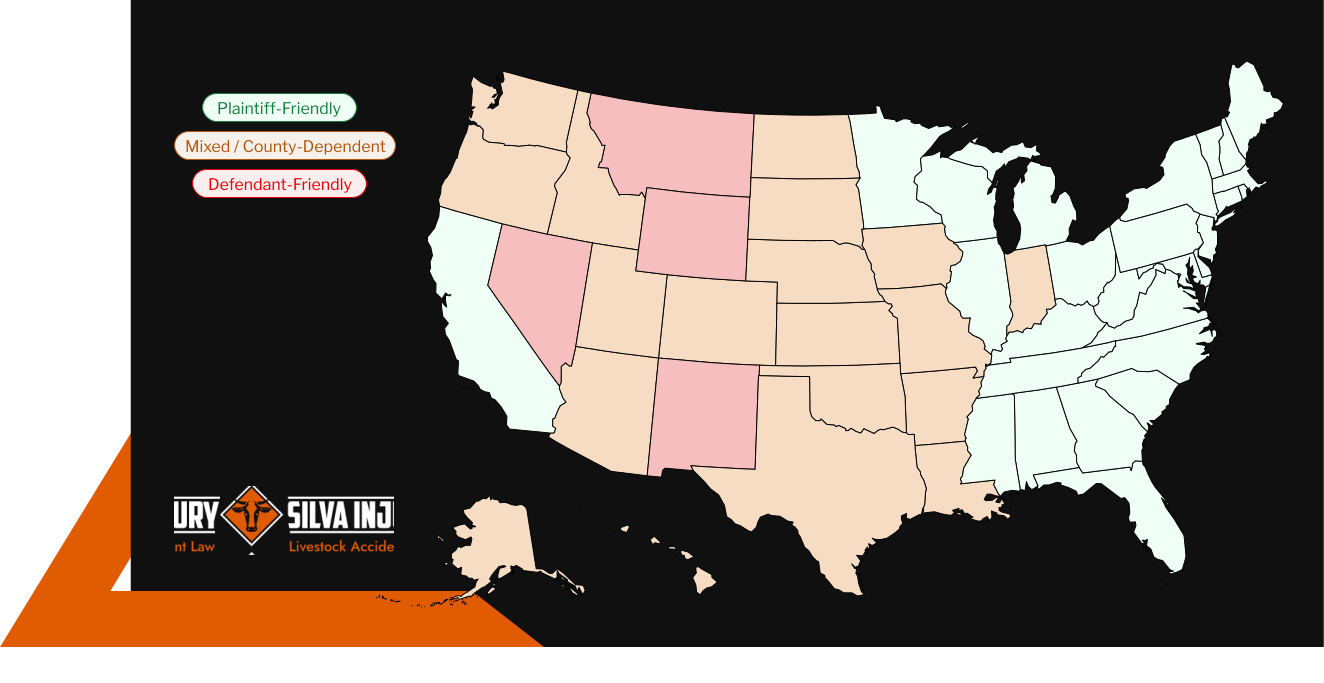
The state statutes are universal, but their application can differ from county to county. Wisconsin gives local governments significant control over livestock ordinances.
I Hit a Cow on the Road. Who Is Responsible in Wisconsin?
The process of determining liability after an accident with livestock involves asking four questions.
Was the Fence “Legal”?
Wisconsin has strict regulations regarding what constitutes a legal fence. If a fence does not meet the required height, material, or strength, the owner is often held responsible. Courts look at:
- Rotted posts,
- Broken or sagging barbed wire,
- Debris-filled cattle guards,
- Makeshift or temporary gates, and
- Weather-related enclosure damage that the owner failed to inspect.
All these factors help the court decide if the owner took sufficient measures to keep the animals in. Even one mistake can be enough to prove negligence.
Did the Owner Know the Cow Might Escape?
Another significant factor is whether the owner should have known cattle might escape. This includes past escapes, police or animal control reports, neighbor complaints, or signs that cattle were testing weak spots.
If any of these warning signs were present, the law would consider the escape predictable, making the injured driver’s case much stronger.
Did the Owner Respond Promptly After Discovering a Breach?
Even if a fence breaks suddenly, such as due to a storm or vandalism, the owner must act quickly. Courts look at whether the fence owner:
- Regularly inspected the fence,
- Delayed needed repairs, or
- Ignored obvious warning signs.
When an owner delays action or overlooks obvious problems, the law views the escape as preventable, undermining any argument that the incident was unavoidable.
Was the Driver Negligent?
Wisconsin uses modified comparative negligence. If the driver is 50% or less at fault, they may be eligible to recover damages. Driver negligence might include speeding, driving while distracted, driving too fast for conditions (especially in fog or dusk), or failing to use high beams in rural areas when appropriate.
Can You Sue If You Hit a Cow in Wisconsin? We Have Answers
Silva Injury Law is one of the few firms in the country with extensive experience in livestock-related crash litigation. We understand how to investigate fence failures, gather evidence of prior incidents, track herd histories, and hold negligent owners accountable under Wisconsin’s fencing laws and “animals at large” statutes.
Cows have owners, and those owners have a duty to keep our roads safe. We’ll help you hold them accountable.
Resources:
- Wisconsin State Legislature. Wisconsin Statutes – Chapter 170: Strays, link
- Wisconsin State Legislature. Wis. Stat. § 895.045, link
- Wisconsin Policy Project – Livestock & Agricultural Policy Analysis, link
- Wisconsin Law Library. Wisconsin Civil Jury Instruction 1391 – Negligence: Owner of Domestic Animals, link
- Wisconsin Civil Jury Instruction 1005 – Ordinary Care, link
- National Agricultural Law Center – Wisconsin Fence Law Summary, link
- Wisconsin Farm Bureau – Right to Farm Law, link
- Wisconsin Legislative Council. Fences in Agricultural Areas, link
Silva Injury Law is licensed in California and Utah. For cases outside these jurisdictions, we work with local counsel or refer cases as appropriate.