Sunset falls fast on Virginia’s rural highways. One minute, you are cruising along Route 29 or cutting through the backroads of Rockbridge County, and the next, you’re turning a bend and heading straight into the unmistakable image of a cow. You slam on the brakes, but physics is against you. The impact is jarring, destroying the front end of your car and leaving you shaken, injured, and stranded on a dark roadside.
Once the shock fades, the questions begin. The biggest one is: Who pays if you hit a cow on the road in Virginia? To determine who is financially responsible after hitting a cow, you need to understand how fencing laws, livestock owner responsibility, and Virginia’s strict negligence rules all intersect in these accident cases.
Virginia Law Starts with the “Fenced-in” Rule
Virginia is a “fenced-in” state, meaning livestock owners have a statutory duty to keep cattle off highways and other public roadways. Livestock owners must keep their animals enclosed within a lawful fence. A fence that does not meet statutory requirements, such as post spacing, height, number of wires, or maintenance obligations, can independently support a negligence claim. Courts routinely treat the failure to maintain a lawful fence as evidence that the owner should have known their animals were likely to escape.
Counties Can Opt into “Open Range” Status
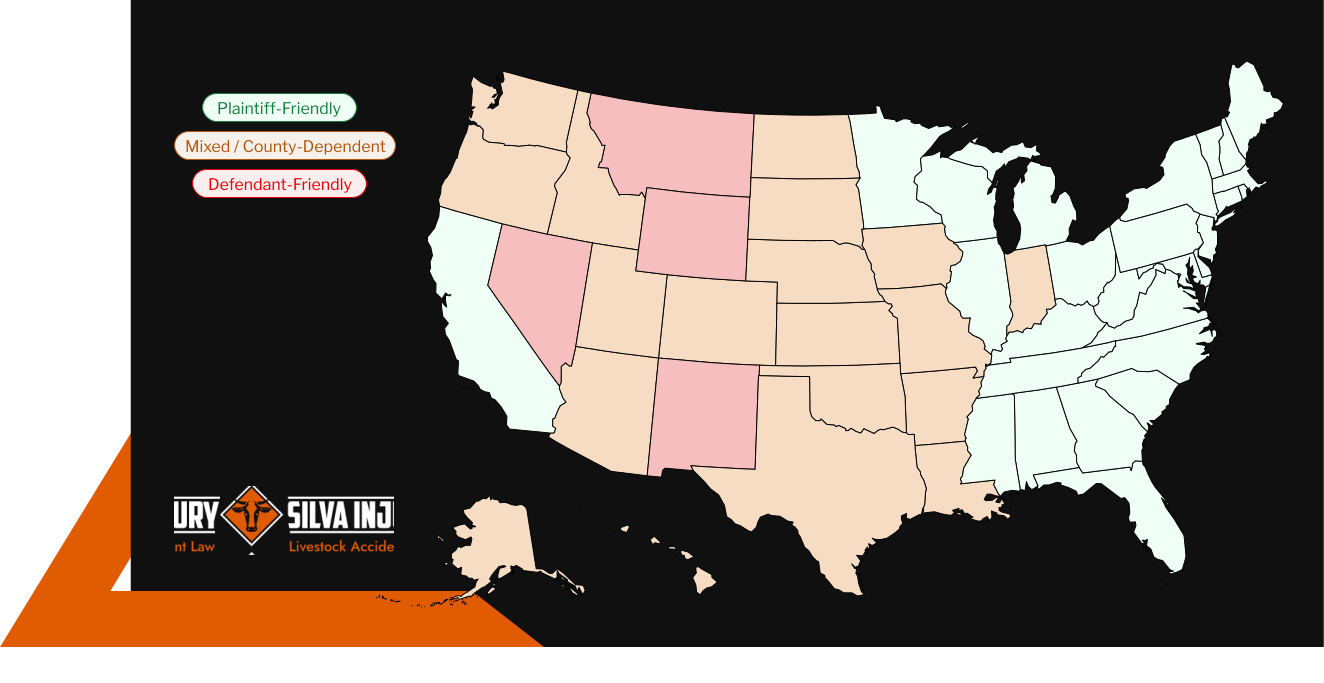
Virginia law technically allows individual counties to declare open-range areas, but only where the county board has formally voted to adopt such a policy. In no-fence counties, the farmer is generally not liable if cattle roam free because they have no legal duty to fence them in. Open-range localities are extremely rare today, and even in no-fence counties, Virginia law generally requires owners to keep livestock off state highways.
The most populated and agricultural counties, such as Bedford, Rockbridge, Augusta, Pittsylvania, and Shenandoah, remain fenced in, meaning that free-roaming cattle almost always trigger owner liability.
If you hit a cow on a primary state road, the farmer is likely still considered to have a duty of care. If you hit a cow on a secondary back road in an open range county, recovery becomes much harder.
I Hit a Cow on the Road—Who Is Responsible?
Establishing liability in a Virginia cow-vehicle collision is a precise process. The law requires you to prove that the livestock owner failed to exercise “reasonable care” in controlling their animals. In the controlling case Rice v. Turner (1950), the Virginia Supreme Court ruled that negligence itself is not proven simply because the owner’s cattle are on the roadway.
To recover damages, you must show how the animal escaped and provide evidence of specific negligence, such as:
- Constructive notice. Was the fence rotted, or were the wires rusted through long before the accident?
- Gate protocols. Was the gate secured with a proper chain or just twine?
- Prior escapes. Had the police been called to this farm for loose cattle before?
Our strategy is to prove that the owner knew or should have known their containment methods were inadequate, through:
- Statutory violations—demonstrating that the enclosure did not meet the strict definition of a “lawful fence”, such as specific wire height or post spacing;
- Gate mismanagement—proving human error, such as witnesses who observed gates left unlatched or secured with temporary, insufficient rigging like bungee cords;
- History of escapes—using animal control records or neighbor testimony to show that this specific herd is a “repeat offender,” which legally puts the owner on notice of a problem; and
- Maintenance failures—identifying physical evidence of neglect, such as rotted wood, rusted-through barbed wire, or cattle guards filled with debris that allowed animals to walk right over them.
The courts will generally only uphold your claim if you can establish these specific breaches in the owner’s duty of care.
The Danger of the 1% Rule
What happens if you hit a cow with your car in Virginia, but a partly to blame? Virginia uses a pure contributory negligence framework. In most states, if you were 10% at fault and the farmer was 90% at fault, you would still receive compensation. However, in Virginia, if you are found to be at fault, regardless of how minor the fault may be, you may be barred from recovering any damages.
This all-or-nothing proposition is the most dangerous aspect of Virginia law for drivers. Livestock owners will aggressively argue that you were:
- Speeding (even 5 mph over the limit),
- Driving too fast to stop within the distance lit by your beams, or
- Distracted.
If they can stick even a sliver of fault on you, the farmer walks away paying nothing, even if they left the gate wide open. Because of this strict rule, you cannot afford to go it alone.
We Handle Livestock Accident Litigation
When livestock ends up on the road, the law gets complicated fast. Silva Injury Law is recognized nationally for pioneering work in livestock collision cases. We step in to handle the investigation, the insurance adjusters, and the legal heavy lifting. Our goal is to secure your total peace of mind so you can focus on what matters most: healing.
If you are a livestock accident victim, don’t wonder whether you can sue if you hit a cow in Virginia. Speak with one of our experienced personal injury attorneys today and let us guide you through the legal process and fight for the outcome you deserve.
Resources:
- Code of Virginia. Title 33.2, Chapter 2 – Highway Systems, link
- Code of Virginia. Title 46.2, Chapter 3. Article 11. Accident Reports, link
- Code of Virginia. Va. Code § 55.1-2810, link
- Virginia Farm Bureau. Overview of Virginia Fence Law, link
- Virginia Tech. Boundaries of Virginia Fence Law, link
- National Agricultural Law Center. Statutes of Virginia – Fence Law, link
- Code of Virginia. Title 8.01 – Civil Remedies and Procedure, link
Silva Injury Law is licensed in California and Utah. For cases outside these jurisdictions, we work with local counsel or refer cases as appropriate.