If you were involved in an accident with a cow, you are probably wondering, I hit a cow on the road; who is responsible? An equally important question is, can I file a lawsuit to seek compensation for my injuries?
Florida law allows you to sue the livestock owners for any injuries caused by their livestock wandering onto public roads. However, you must prove the owner was negligent or acted purposefully.
Can You Sue If You Hit a Cow?
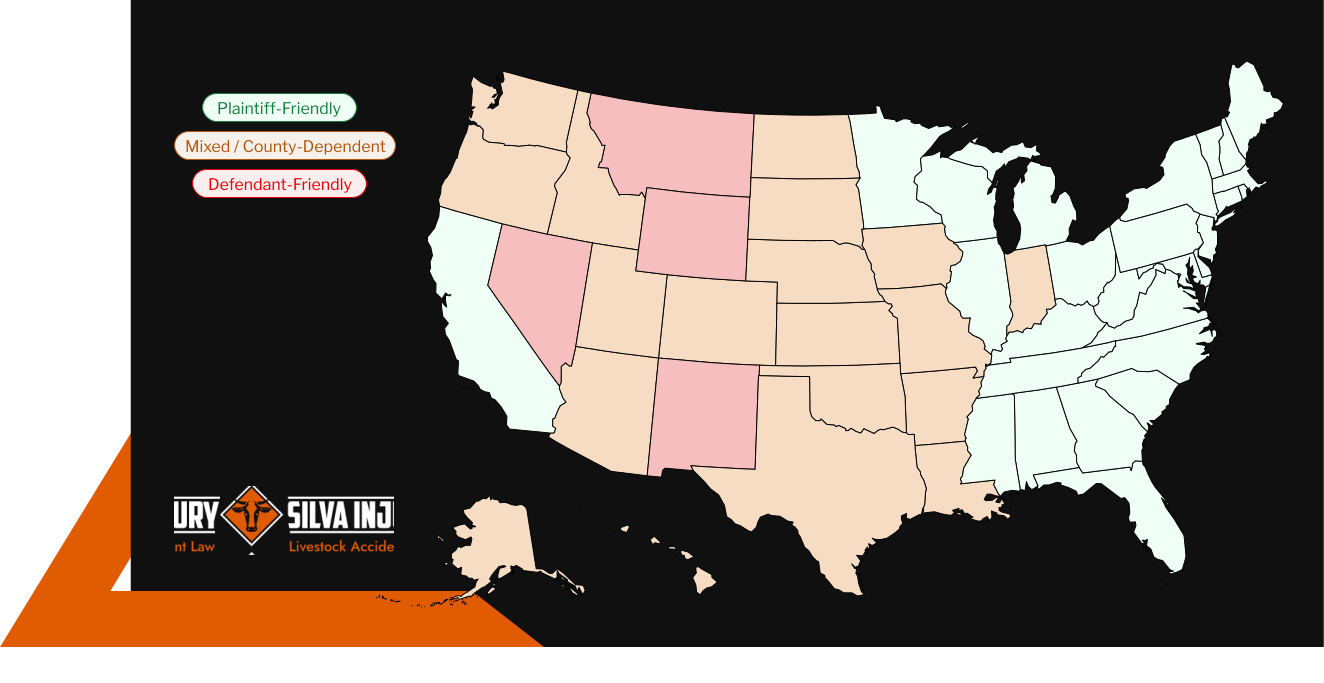
Unlike other states that have a mix of open and closed-range laws, Florida has established a statewide livestock law, making it a closed-range state. Under the law, any livestock owner who “intentionally, willfully, carelessly, or negligently” allows their livestock to wander onto public roads of the state is liable for the injury and damage caused.
Livestock Owner
An owner is any person, association, firm, or corporation that owns, has custody of, or is responsible for livestock. This can include:
- The individual who owns a single livestock,
- A rancher who owns several cattle or horses,
- Dairy farm company,
- An animal rescue shelter,
- A farm or ranch manager is in charge of overseeing livestock, and
- A livestock transporter.
Legal owners are not the only possible liable party. Your seasoned attorney will review the facts of your case to identify all possible accountable parties.
State of Mind
You must prove that the party you are suing “intentionally, willfully, carelessly, or negligently” permitted the livestock to wander onto the public roads. It’s not enough just to prove that the livestock escaped and found their way onto the road.
You must, absent evidence of actual intent, show that the owner negligently allowed the livestock to stray onto public roads. Common examples of owner negligence include:
- Choosing not to fence in the livestock,
- Failing to inspect the fence or barrier for faults,
- Releasing livestock from the property,
- Failing to fix a broken barrier,
- Forgetting to close the fence,
- Repeated instances of escaped livestock, and
- Failing to train employees to close the gate
If you cannot prove evidence of negligence or intent, you won’t be able to recover compensation for your injuries. A livestock accident lawyer can assess the circumstances that led to the cow wandering into the road to determine whether you can bring a lawsuit.
Wander onto the Public Roads of the State
Public roads refer to roads in Florida that are maintained by the state, a political division of the state, or a municipality. A lawyer can help you determine whether the road on which your accident happened is considered a public road.
If the accident occurs on a private road, you cannot file a claim based on the Florida statute. However, Florida is still a fenced-in state. You may be able to file a common law negligence claim if you can prove the owner failed in their duty to maintain a fence.
Who Pays If You Hit a Cow on the Road in Florida?
To file a claim for damages, you must know who to sue. But how do you know who owns the cow you hit? Here are a few ways to find out:
- Brand registration. Florida law requires that any marks or brands on livestock must be recorded with the Florida Department of Agriculture and Consumer Services (FDACS). The local law enforcement office will be able to assist you in identifying the brand and matching it to the owner.
- Check for tags. Many ranchers use ear tags or electronic ID on their livestock. You can match these tags with their owner.
- Ask property owners in the area. Florida property owners generally know who their neighbors are, whether a cow is lost, and which livestock belongs to which property.
- Sheriff’s office. The sheriff might know who the cow belongs to. In rural counties, the sheriff’s office may be familiar with the local ranchers and can identify the owner.
Identifying the owner of a cow can generally be straightforward with the use of RFID chips, brand registration, and community assistance. A lawyer can help facilitate this process to ensure the appropriate parties are included in the claim.
How Long Do I Have to Bring a Livestock Accident Claim in Florida?
You generally have two years from the date of the accident to bring a personal injury claim. This deadline is called the statute of limitations. If you fail to meet it, you generally won’t be able to recover any compensation.
Let Us Help You Get the Justice You Deserve
Don’t be left wondering what happens if you hit a cow with your car in Florida. Our attorneys at Silva Injury Law can review your case to determine if you can file a lawsuit against the owner of the cow.
Let us worry about your case. Our attorneys are dedicated to fighting for your rights and providing you with support throughout your recovery.
Contact us now for a free case evaluation.
Resources:
- Carnahan v. Norvell, 270 So. 3d 414 (Fla. App. 2019), link.
- Fisel v. Wynns, 667 So. 2d 761 (1996), link.
- Definitions, Fla. Stat. § 588.13 (2025), link.
- Recording of marks or brands, Fla. Stat. § 534.021 (2025), link.
- Livestock at large; legislative findings, Fla. Stat. § 588.12 (2025), link.
- Selby v. Bullock, 287 So. 2d 18 (1973), link.
Silva Injury Law is licensed in California and Utah. For cases outside these jurisdictions, we work with local counsel or refer cases as appropriate.